Trafilata al Bronzo: Why Bronze Die Extrusion Outperforms Teflon
An engineering breakdown of how microscopic brass abrasive resistance carves porous micro-grooves into extruded durum wheat, creating superior capillary sauce adherence.
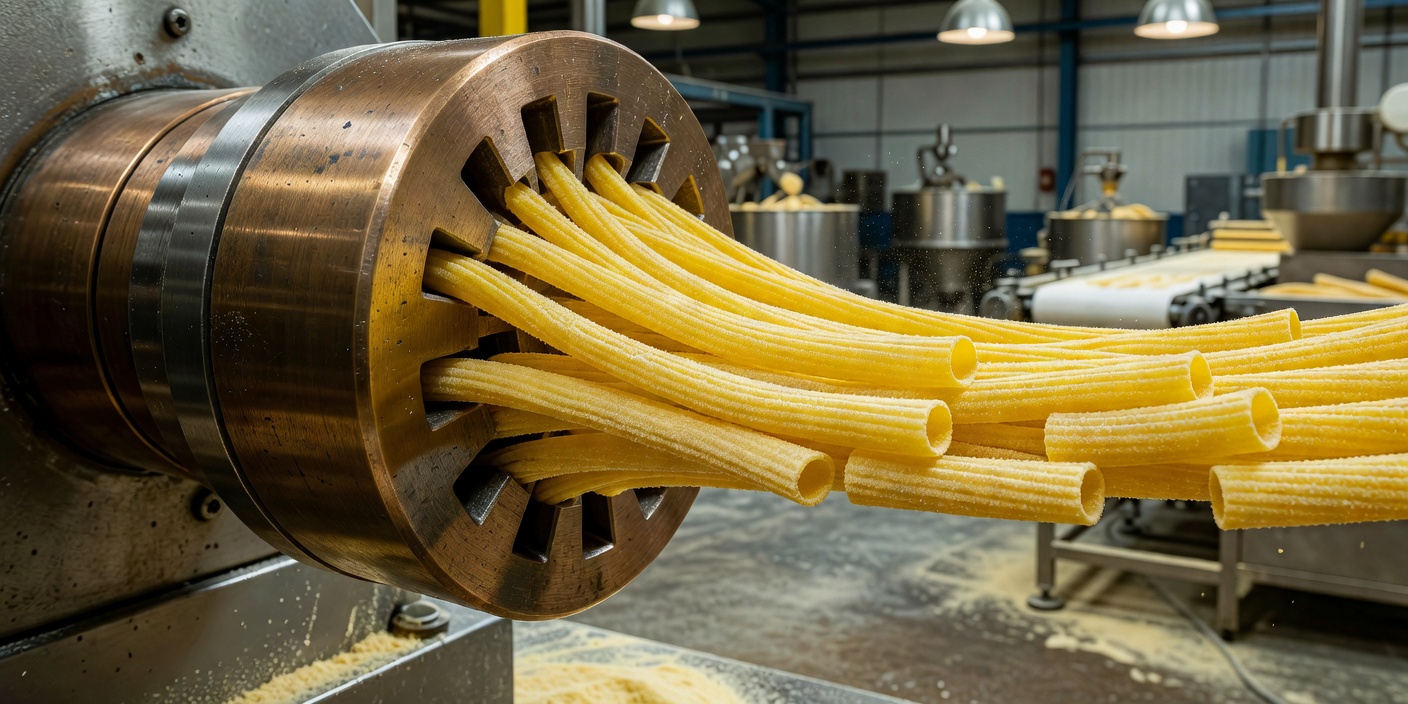
An engineering breakdown of how microscopic brass abrasive resistance carves porous micro-grooves into extruded durum wheat, creating superior capillary sauce adherence.
In commercial pasta production, hydrated durum semolina (at roughly 30% moisture content) is driven through an Archimedes screw auger under tremendous mechanical pressures ranging from 80 to 120 atmospheres (bars). As this dense dough is forced through the precision aperture of an extrusion die (trafila), friction between the die material and the dough mass dictates the micro-topography of the finished pasta strand.
| Characteristic | Bronze-Extruded (Trafilata al Bronzo) | Teflon-Extruded (PTFE Die Inserts) |
|---|---|---|
| Surface Roughness (Ra) | High (5.2 – 8.5 µm) • Matte, chalky white | Low (0.4 – 1.1 µm) • Glossy, translucent amber |
| Extrusion Speed / Friction | High friction • Requires slower extrusion speeds | Ultra-low friction • Enables high-speed output |
| Cooking Starch Release | Controlled amylose leaching enriching the pasta water | Minimal surface leaching; water remains thin |
| Sauce Binding Coefficient | High (Capillary wicking of lipids & emulsions) | Low (Hydrophobic shedding; sauce puddles at bottom) |
The surface of bronze-cut pasta is characterized under electron microscopy by micro-tears and porous indentations. When submerged in a boiling pot, these micro-pores expand and release fine amylose starches into the cooking liquor. During the subsequent mantecatura (vigorous pan tossing with fat and cooking water), the released starches act as natural surfactants, stabilizing cheese, oil, and collagen emulsions directly against the pasta ribbon.
In the historic pasta capital of Gragnano (Campania), the European Union protected geographical indication (I.G.P.) strictly mandates that all certified pasta must be extruded exclusively through bronze dies and dried at low temperatures (below 55°C) for up to 60 hours.
Industrial producers frequently substitute Teflon (polytetrafluoroethylene) inserts because slick plastic speeds factory throughput and extends die longevity. However, this produces a shiny, glass-like exterior that acts like a hydrophobic slide, shedding delicate olive oil and seafood nectars into the basin of the bowl.
When selecting dried pasta for oil-based emulsions (Aglio e Olio, Vongole) or high-starch cheese sauces (Cacio e Pepe, Carbonara), bronze-die extruded pasta is not a luxury aesthetic preference—it is a functional physical requirement for sauce cohesion.